Author’s Note: Given President Trump’s continued assault on the administration of elections in the US, it’s important to detail for all voters the full scope of their rights under the law and how to protect them. On the matter of deploying federal government immigration and law enforcement officers to the polls, I trust this will help explain to all voters their rights and how to protect them.
One recommendation that is not covered in this issue brief is for voters to attend their city council and county board meetings to ask what plans, if any, city and county law enforcement officials have to address the possible appearance of federal immigration or law enforcement officials at polling locations.
The Los Angeles County Clerk – Recorder’s Office provides an excellent example of the plans that office has in place for administration of upcoming elections.[1] Be diligent in ensuring that your city/county/town officials (who have primary responsibility for administration of elections along with the state) are well prepared for whatever situation might arise AND that the public is well informed of those preparations.
See Part 2 for an overview of current federal and state legislation on this subject.
A. Overview of Federal and State Laws
Brennan Center for Justice, “Explainer: Sending ICE to Polling Places Is Illegal,” (March 31, 2026).[2]
Can the president send ICE agents to polling places? No. Elections are special. There are specific federal and state laws that make this kind of action unlawful.
Sending ICE or any other armed federal agents to the polls is illegal because federal law bans federal officers from interfering in elections. It’s also illegal because federal law bans troops and armed federal agents from being deployed anywhere an “election is held.” While that law was passed in 1865, surely in today’s elections, that means wherever votes are cast and counted, including, polling places, vote-counting facilities, and drop boxes. And any kind of voter intimidation, including by federal agents, is illegal under both federal and state law regardless of where it happens.
Can ICE agents be near polling locations if they remain outside? ICE has no reason to be at or near the polls. ICE is part of the Department of Homeland Security, which has no role in enforcing election laws.
Given ICE agents’ extreme actions in Minneapolis and elsewhere, even their presence at or near the polls can intimidate voters or anyone administering an election, which is illegal.
Shouldn’t law enforcement be able to respond if there is some kind of threat of violence at a polling place? State and local election officials run elections and have primary responsibility for ensuring the safety and security of polling places. The presence of law enforcement at the polls can be intimidating, so election officials work hand in hand with state and local law enforcement to ensure they are prepared to respond appropriately in the event of emergencies without needlessly causing intimidation.
In rare instances, it might be valuable to have support from federal law enforcement, but only if they are working together with local law enforcement, and not in the form of armed deployments to the polls. In fact, the federal law prohibiting federal armed agents from the polls has been on the books since the Civil War. There is no instance in which it would make sense for immigration officers to be involved.
What can voters do if ICE agents show up at polling places? If any voter, election official, or election worker is intimidated during an election, they can go to court to protect their rights. Courts have processes to rule quickly to prevent election disruptions or voter intimidation.
Voters should report the presence of ICE agents to their local election officials. They can also call or text 866-OUR-VOTE if they have any issues voting or questions about how to vote.
Americans should also check their voter registration status now, learn their voting options well in advance of the election, and make a plan to vote early however they choose, including in person, by mail ballot, or at a drop box where available.
What can state lawmakers do to protect voters? States already have laws on the books to keep ICE and other federal agents from intimidating voters or interfering in elections. State legislators can do more by reinforcing the federal prohibitions on such conduct. As outlined in a model bill drafted by the Brennan Center, states can establish criminal penalties against federal forces that interfere in elections or intimidate voters.[3] This would enable federal agents to be held accountable even if the Department of Justice refuses to prosecute.
What can election officials do? Election officials are always working hard to make sure elections are free, fair, secure, and accurate — and that every eligible voter can cast a ballot without being intimidated.
Ahead of the midterms, that preparation can involve coordinating with local law enforcement and county attorneys, as well as conducting trial runs to practice how to respond in the event that ICE agents are deployed to polling places.
Election officials can also reach out to local community groups, voter engagement organizations, and the people who run schools, libraries, and other voting locations to discuss how to help the community feel safe.
Daniel, George, “Explainer: Can ICE Be Near Polling Sites? What the Law Allows — and What the White House Didn’t Explain,” Lawyer Monthly (February 6, 2026).[4]
A voter casts a ballot at a polling station during a US federal election. Questions around law enforcement presence near voting sites have drawn renewed scrutiny ahead of the midterms.
Can ICE Be Near Polling Sites? What the Law Allows — and What the White House Didn’t Explain. When the White House said it could not guarantee that Immigration and Customs Enforcement agents would not be near polling places during the 2026 midterm elections, the comment triggered widespread concern and a rush of near-identical headlines. Most coverage focused on what was said in the briefing. Far less attention was paid to how election-day enforcement authority actually works, and why the absence of a “formal plan” does not fully resolve the issue.
This article explains what the existing reporting leaves out.
What the White House Did — and Did Not — Say. At a February briefing, White House press secretary Karoline Leavitt said she had not heard Donald Trump discuss any “formal plans” to deploy ICE agents at polling sites. She also declined to guarantee that ICE agents would not be present near voting locations, describing the scenario as hypothetical while stopping short of ruling it out.
Those two statements are often treated as a single position. In practice, they are not. Saying there is no formal plan addresses presidential intent. Declining to give a guarantee reflects how federal enforcement authority already exists below that level.
Who Actually Controls ICE Deployment on Election Day. ICE does not operate through election-specific directives. It sits within the Department of Homeland Security, where national leadership sets priorities but regional field offices retain day-to-day discretion over enforcement activity. Unless restricted by policy guidance or court order, that authority continues to apply on Election Day.
This structure matters because it means the lack of a White House directive does not automatically prevent ICE agents from being present in a given area. “No formal plan” does not mean “no possible presence.” It means no new instruction has been issued from the top.
What Federal Law Prohibits — and What It Doesn’t. Federal law draws a firm line between military forces and civilian law enforcement during elections. The president is barred from deploying military troops at polling places. ICE agents, however, are civilian law enforcement and are not covered by that prohibition.
There is no statute that categorically bans ICE agents from being near polling locations. The legal risk arises when enforcement activity interferes with voting, intimidates voters, or obstructs access. In those cases, civil rights and election-protection laws can come into play. Presence alone is not automatically illegal; conduct is what determines legality.
Why “Near a Polling Site” Is a Critical Distinction. Most headlines collapse “at the polls” and “around polling sites” into the same idea. Legally, they are different. Polling places are often located in schools, churches, or municipal buildings where law enforcement may already be present for unrelated reasons.
Concerns escalate when enforcement activity appears targeted, visible, or timed in a way that discourages voting. That ambiguity is central to the issue. It is also why election officials focus less on formal deployment announcements and more on how authority is exercised in practice.
What Has Happened in Past Elections. Historically, federal agencies have avoided visible enforcement activity near polling places on Election Day. That restraint has often relied on internal guidance and political norms rather than explicit statutory bans.
Because those norms are not always codified, they can change without new legislation. Past avoidance does not create a permanent legal barrier, but it does explain why even the suggestion of enforcement presence near polls attracts scrutiny.
What States Can Do If Federal Agents Appear Near Polls. States administer elections, but they do not command federal agents. If enforcement activity interferes with voting, states can seek emergency court orders or pursue civil rights claims. They can also enforce state laws against intimidation or obstruction.
What states cannot do is directly order federal agents to leave polling areas. Any restriction on federal activity typically requires judicial involvement, which is why disputes involving Election Day enforcement often move quickly into court.
What Would Change Between Now and November? Several developments would materially alter the legal landscape. Formal guidance from the Department of Homeland Security or the Department of Justice restricting enforcement near polling places would clarify boundaries. Court rulings addressing pre-election enforcement actions could do the same. Executive orders or litigation expanding federal authority would move the issue in the opposite direction.
Until then, the situation remains unresolved not because a plan exists, but because enforcement authority already does.
The Bottom Line. The current reporting accurately reflects what the White House said. What it largely omits is how federal enforcement authority operates in practice, and why the absence of a “formal plan” does not fully settle the question.
The real issue is not whether ICE has been ordered to appear at polling sites. It is whether existing powers will be clarified, constrained, or tested as Election Day approaches. That question remains open.
National Conference of State Legislatures, “Polling Places,” (July 16, 2026).
…. Federal and state laws provide guidance on the roles that police (and other uniformed officers) can have at polling places on Election Day or during in-person early voting. These regulations are intended to prevent intimidation or interference with free elections.
State laws are varied, but in general, police may be present at polling places for the purpose of law enforcement. The table below provides statutory excerpts. In summary:
Five state affirmatively indicate that police officers shall be stationed at polling places or be on notice to appear if requested (Alabama, Arkansas, Massachusetts, New York and Wisconsin).
Sixteen states are silent on police at polling places (Alaska, Arizona, Colorado, Delaware, Hawaii, Idaho, Kansas, Michigan, Mississippi, New Hampshire, North Dakota, Oklahoma, Oregon, Texas, Vermont and Wyoming).
Twenty-nine states and the District of Columbia allow police to be requested, summoned or given permission to come to enforce the law or on official business (California, Connecticut, Washington, D.C., Florida, Georgia, Illinois, Indiana, Iowa, Kentucky, Louisiana, Maine, Maryland, Minnesota, Missouri, Montana, Nebraska, Nevada, New Jersey, New Mexico, North Carolina, Ohio, Pennsylvania, Rhode Island, South Carolina, South Dakota, Tennessee, Utah, Virginia, Washington and West Virginia).
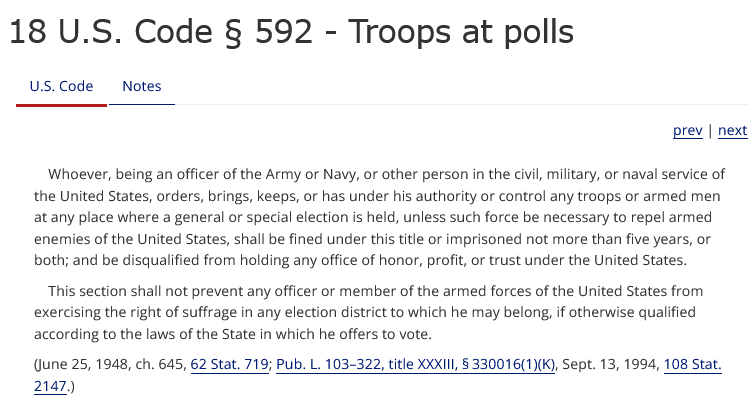
Federal law clearly prohibits the deployment of troops and armed agents to polls.
Ordering troops or armed forces to a polling place is a federal crime (18 U.S.C. § 592).
Officers and members of the Armed Forces are generally prohibited from interfering in elections through intimidation of voters and other related conduct (18 U.S.C. § 593, §10102).
Protect Democracy, “How to Spot (And Push Back Against) Federal Voter Intimidation,” (June 18, 2026).[5]
What Could Federal Voter Intimidation Look Like?
The interference could take several forms:
Increased presence and visibility of Immigration and Customs Enforcement (ICE), federal agents or other militarized agents in the leadup to the election, including through unjustifiably invoking the Insurrection Act;
Local or state law enforcement, particularly in jurisdictions with 287(g) agreements that mandate cooperation with Department of Homeland Security (DHS) agents, stationed at polling sites;[6]
And least likely, immigration or other militarized federal agents deployed directly to polling sites.
It may only take a single viral incident in one jurisdiction to suppress turnout across the country. And whether or not ICE or other armed federal agents appear near polling locations, the threat alone is enough to chill participation.
These and other forms of federal interference would be a deliberate show of force, designed to intimidate voters, particularly naturalized citizens and communities of color. Alongside the administration’s repeated and baseless lies that “noncitizen voting” threatens election integrity, this creates an environment of fear designed to deter eligible voters from participating in the midterms.
Voter suppression and violence toward targeted groups in our democracy are not new. They are a common thread running through our national story, rooted in slavery and Jim Crow, and spanning disenfranchisement, gerrymandering, intimidation, and outright violence designed to drive targeted communities from public life. The Supreme Court’s recent gutting of the Voting Rights Act in Louisiana vs. Callais and several southern states’ rush to redraw their voting maps in ways that dilute the voting power of communities of color make plain that these are not tactics of the past.
Would This Kind of Interference Be Legal?
Over the last year, this administration has used armed federal agents to threaten demonstrators, journalists, and observers by using unlawful force to quash protests against the administration’s actions. Under the guise of immigration enforcement, the administration has surged DHS agents across the country to intimidate neighbors who oppose their actions, including those who exercise their rights to lawfully speak out in dissent or to record the federal agents’ hostilities. The government engaged in violent tactics against protesters in 2020, but the scale and reach of the aggression has intensified.
These tactics have sought to instill fear and to disrupt daily life in the affected cities, particularly in targeted communities. If something similar happens in or near competitive electoral districts this fall, there is little doubt that the administration will be attempting voter intimidation and suppression. It is just as illegal for the administration to use a show of force to interfere in contested election districts as it would be for it to send ICE or other militarized agents directly to polling locations
Using force to make voters fearful to participate in our elections is prohibited voter intimidation, whether it is from federal forces, local law enforcement, or private citizens. Specifically:
It is illegal to deploy federal “troops or armed men at any place where a[n] … election is held,” unless in the extreme circumstances of war or rebellion. This includes the deployment of federal immigration agents or federalized National Guard in or around election locations.
It is illegal to coerce or threaten election observers and mobilizers, threaten voters about their qualifications to vote, spread false voting information or eligibility requirements, and to target non-English speakers and voters of color, among other forms of unlawful voter intimidation.
The Insurrection Act puts additional meaningful checks on the threat of domestic deployments.[7] The bar for invoking the Insurrection Act is very high. It requires a genuine crisis, and historically, it has been limited to severe instances of civil unrest and to defend the rights of marginalized groups. Courts can review and curtail an invocation of the Insurrection Act. Critically, the Insurrection Act does not suspend the Constitution, impose martial law, or change how we can defend our constitutional rights and civil liberties.
Federal National Guard deployments are also tightly regulated, and can’t legally be undertaken without appropriate justification and process. For example, the Supreme Court recently ruled that the Trump administration could not federalize National Guard troops during a DHS surge in Chicago and the Court emphasized the legal constraints on mobilized guardsmen conducting law enforcement. It remains within each Governor’s discretion whether they call up their state’s National Guard. Even when troops are legally deployed, they can’t legally interfere in elections. State statutes and constitutions provide additional constraints to protect voters from federal forces.
These efforts are designed to make us feel small and powerless. But they will not succeed when everyday Americans are committed to peacefully participating and showing up for their neighbors. Regardless of who you vote for, how much time you have, or where you stand in your community, there is a role for you in ensuring free and fair midterms: posting on social media; supporting neighbors in developing plans to vote early, vote together, or vote by mail; volunteering as a familiar face at polling locations; learning deescalation tactics; or joining a local election protection coalition will all make a difference.
What You Can Do About It
Pre-election
Make plans to go vote with your neighbor, friends, family members and provide support if they are unsure about their voting plans.
If allowed by your state, vote early or by mail.
Attend a know your rights training from partners like ACLU, and share learnings with friends and family.
Post positive messages about voting on social media and hang flyers in your neighborhood. The Election Protection Hotline has a great toolkit!
Host a community dinner and bring up voting plans.
Join your local Election Observer Programs through trusted partners such as: League of Women Voters and Election Protection Hotline.
Join your local Peacekeepers program.
Familiarize yourself with best practices around identifying and countering misinformation and AI-generated content.
Familiarize yourself with trusted resources on voting information such as through your State Election Board which you can find through the Election Assistance Commission.[8]
Save the voter protection hotline to your phone. English: 866-OUR-VOTE (866-687-8683). Spanish: 888-VE-Y-VOTA (888-839-8682).
During Voting
Go vote with your friends, family and neighbors! Make it a community event to celebrate the joy of voting.
Participate in a HALO event, Souls to the Polls, or any other event where your community is voting together.
Participate as a poll observer or poll worker.[9]
Use the voter protection hotline if issues arise: English: 866-OUR-VOTE (866-687-8683) & Spanish: 888-VE-Y-VOTA (888-839-8682)
Utilize your deescalation skills. Check out the Bridging Divides Initiative’s Deescalation Directory for a repository of deescalation resources to support different community members, whether elected government officials, election and poll workers, those engaging with law enforcement, or everyday community members, volunteers, and bystanders.[10]
Film interactions with federal agents and report to the voter protection hotline, if you are comfortable and it is legally allowed. Use judgment about whether filming or photographing federal agents would escalate a situation and refrain from doing so in those circumstances.
Consult state laws to determine whether and under what conditions recording devices are permitted at the polls.
Make sure to follow guidelines and laws for recording near or at polling locations.
Be aware of potential threats from individuals who use social media and streaming platforms to create content that promotes bigotry and undermines democracy.
Taylor, Miles, “Local Prosecutors Warn Trump: “If You Send ICE to the Polls, We’ll Put Them In Jail,” Defiance.News (May 19, 2026).[11]
Donald Trump refused to rule out sending ICE agents to the polls in November. So prosecutors across America are sending a message: FAFO.
Today, a coalition of locally elected district attorneys and prosecutors from across the United States have officially put the Trump administration on notice: any federal agent who shows up at a polling place in violation of state or federal law will be investigated and prosecuted under the laws of the jurisdiction in which they act. And they will be jailed, if needed.
The announcement, made by the Project for the Fight Against Federal Overreach — “FAFO” — was first reported by Politico and comes a week after President Trump refused to rule out deploying ICE officers to polling locations during the November elections. Legal scholars across the political spectrum had already warned that such a deployment would constitute unlawful voter intimidation under federal civil rights statutes and state election codes. This morning, the prosecutors who would actually have to bring those charges stepped forward to say they are prepared to do so.
FAFO’s founding membership reads as a map of jurisdictions that have already absorbed the brunt of federal overreach in the past year: Philadelphia, Minneapolis, Tucson, Austin, Dallas, Norfolk, Portsmouth, Fairfax, and Arlington, among others. More district attorneys are expected to sign on in the weeks ahead. The coalition was incubated by DEFIANCE.org and was spun off recently as an independent nonprofit organization at FederalOverreach.org.
…. Philadelphia District Attorney Larry Krasner, who joined the announcement, delivered the morning’s most pointed warning.
“Anyone — federal agent or otherwise — who shows up at a polling place in Philadelphia to intimidate voters is going to find out what ‘find out’ means,” Krasner said. “A federal badge is not a license to violate the Constitution, and it is not a shield from state criminal law. We have prosecuted police officers who broke the law. We have prosecuted public officials who broke the law. We will prosecute ICE agents who break the law. There is no category of American who gets to operate above it.”
Hennepin County Attorney Mary Moriarty, whose office has already filed charges against federal agents in Minnesota and is currently litigating against the Department of Homeland Security over the administration’s deployment of federal forces in Minneapolis, said FAFO members are preparing now to ensure no ambiguity about what will follow a November deployment.
“The right to vote without fear of armed government agents at the polls is not negotiable, and it is not subject to the whims of a president,” Moriarty said. “Federal law makes voter intimidation a crime. Minnesota law makes voter intimidation a crime. If ICE officers are dispatched to polling places in Hennepin County to frighten voters away from the ballot box, my office will investigate, and we will charge. Every prosecutor in this coalition is preparing for that possibility now, before November, so there is no ambiguity about the consequences.”
The legal architecture behind the coalition’s threat is well established. Under federal law, 18 U.S.C. § 594 prohibits intimidation of voters at federal elections, and 52 U.S.C. § 20511 imposes criminal penalties for interference with voter registration and voting. State statutes in nearly every FAFO member jurisdiction independently criminalize voter intimidation, assault, false imprisonment, and abuse of authority — charges that can be brought against federal agents acting outside the scope of their lawful duties.
The announcement lands amid a documented escalation in the Trump administration’s use of federal law enforcement for domestic political purposes. ICE and other DHS components have been deployed to American cities over the objections of state and local officials. Earlier this year, state election records were seized in Georgia, and the president has publicly signaled the potential use of the Insurrection Act and other emergency authorities to exert federal control over states and even election administration.
Against that backdrop, FAFO represents the first organized effort by elected prosecutors to draw a line at the state level and to put the line in writing.
DEFIANCE.org, which incubated the coalition before its spinoff, has positioned itself in the past year as one of the central organizing hubs of the pro-democracy “rapid response” to the second Trump administration. The organization has launched a series of campaigns aimed at federal accountability, including the FAFO project, efforts to support whistleblowers sounding the alarm about unlawful presidential orders, lawsuits against Trump’s unconstitutional actions, a nationwide response network to shut down ICE secret prisons, and more.
The coalition is expected to announce additional jurisdictions in the coming weeks, and members have indicated they will hold a joint briefing in Washington in advance of the November elections.
Whether the Trump administration follows through on its refusal to rule out an ICE deployment to polling places is, for now, an open question. What is no longer open is the question of what will happen if it does. The prosecutors in the FAFO coalition are telegraphing to Trump and his agency heads — in the only language that matters in a courtroom — that no one in this country is above the law, and that a uniform is not a hall pass to commit crimes against American voters.
B. Additional References
American Civil Liberties Union, “Know Your Rights: Federal Agents at the Polls,” (June 16, 2026).[12]
Gilbert, David, “Election Officials Are Getting Ready for ICE to Show Up at the Polls,” Wired (May 28, 2026).[13]
Knutson, Jacob, “ICE Agents Confront New York Poll Worker During Voting, As State Prosecutors Review Incident,” Democracy Docket (June 25, 2026).[14]
Macias, Martin, “Migra At the Polls: What To Do If ICE Shows Up At LA Voting Sites,” Los Angeles Public Press (May 4, 2026).[15]
Maurer, Dan, “Rules of Engagement When the Troops Appear at Polling Sites,” Lawfare (June 3, 2026).[16]
National Policing Institute, “Public Safety and Elections: A Guide for Law Enforcement,” (July 2024).[17]
_____________________, “Policing in a Time of Elections,” (July 2024).[18]
North Carolina State Board of Elections, “Elections Reference Guide for North Carolina Law Enforcement,” (January 2024).[19]
Phillips, Michael, “Why Federal Forces Are Barred From Polling Places — And What the Law Actually Says,” Election Desk (January 21, 2026).[20]
Shorman, Jonathan, “Blue States Push to Ban ICE At the Polls Amid Federal Voter Intimidation Fears,” Stateline (March 5, 2026).[21]
[As usual, the full issue brief, including footnotes and graphics, appears in the attached PDF.]