Author’s Note: California voters recently made news, and not in a good way. Election officials announced that, despite efforts to combat the problem of lost votes, nearly 150,000 ballots were rejected during the recent California Primary Election. Almost all the rejections were due to avoidable errors (especially not having the mail ballot postmarked before the close of the polls on Election Day).
I thought, therefore, that I would do a post impressing upon everyone the nature and scope of the “lost votes” problem.
I’d suggest as well that if you find instructions confusing (either on ballots or election materials), let your local election officials know that. Pennsylvania redesigned its election materials after a high rejection rate made them realize that design flaws were part of the problem. So speak up if you see a problem!
A. Examples of Common Mistakes & Their Scope
Blood, Michael, “Nearly 150,000 Mail Ballots Rejected in California’s Primary Despite Efforts to Count Every Vote,” AP News (July 24, 2025).[1]
Nearly 150,000 California voters had their mail-in ballots rejected for the state’s June primary, a spike from recent elections even as the state attempts to make voting easier with the goal of boosting participation and counting every ballot.[2]
Late-arriving ballots drove the rejections. According to state data, 148,241 mail ballots were rejected in the June election, or a rate of 1.73% of all mail ballots. In raw numbers, that’s up from the 2024 primary, when 108,982 mail ballots were rejected, or a 1.56% rate. In 2022, 105,818 mail ballots were voided during the primary, or a rate similar to 2024.
Lateness accounted for 93,479 rejected ballots in June, by far the largest category for disqualifying a ballot. That was up from about 70,000 in the 2022 primary and about 76,000 in the 2024 primary, though turnout in those elections was smaller compared to last June.
Kim Alexander, president of the nonpartisan California Voter Foundation,[3] said … “Ballots rejected due to lateness are caused primarily to being postmarked too late to count, not because they arrived too late to count,” Alexander wrote in an email.
Rejection rates have fluctuated over time, but the growing number of those set aside for lateness compared to recent elections “does really demand the question why this is happening,” said Mindy Romero, director of the Center for Inclusive Democracy, a nonpartisan research group.[4]
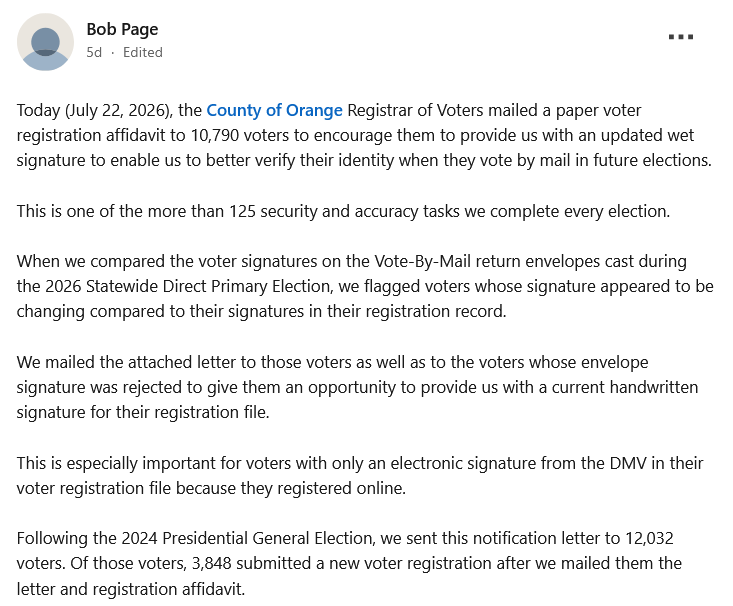
…. Mismatched Signatures and Multiple Ballots In An Envelope. Nearly 44,000 ballots were set aside because the voter’s signature didn’t match the one on record with county officials.[5] Over 8,300 ballots were rejected because there was no signature on the returned ballot envelope.
In 743 cases, the voter had already cast a ballot, so the mail ballot was voided. Other reasons for rejection included a ballot being missing from the return envelope, or multiple ballots were sent back in a single envelope.
Drew, Micah, “Hundreds of Ballots Rejected Following New Law Requiring Voters Write Birth Year On Ballot Envelopes,” Daily Montanan (October 23, 2025).[6]
A new Montana law requiring a voter’s birth year has led to county election officials rejecting an abnormal number of ballots for this year’s local elections.
Ballots sent to Montana voters this election year look a little different than in years past. Underneath the ballot envelope’s signature line are four rectangles, with instructions to fill in a voter’s birth year. The change comes from a law passed by the 2025 legislature that was intended to increase voter security by adding another layer of verification to absentee ballots.
In one county that had a practice run with the requirement, voters have adjusted, although a county official said the federal election next year will require significant outreach. However, the law also gives voters an additional chance to make a mistake, and some counties are seeing rejection rates soar as a result.
“This was our concern at the Legislature, that this law could cause otherwise valid ballots to be rejected, and unfortunately we’re just seeing it come to fruition,” Missoula County election administrator Bradley Seaman told the Daily Montanan on Wednesday. “We’ve got about a 4% rate of rejected ballots, up from just fractions of a percent we normally see. We have a very high rejection rate this year, and the main reason is people are missing the dates.”
Seaman said that as of Wednesday, with another week and a half to go before Election Day, his office in Missoula had rejected 467 ballots — 357 of them due to a missing or incorrect birth year. By comparison, in Missoula county’s 2023 municipal election, only 142 total ballots were rejected due to a missing or mismatched signature, out of nearly 25,000. “It’s critical that every vote matters,” Seaman said, pointing to the previous city council election where one race ended in an exact tie.
If a ballot is rejected, a county elections office will send a letter to the voter’s address, and if possible, send an email or call them. Once notified, voters are able to resolve issues with their ballot until 5 p.m. the day after the election, either in person, or by mail or email, by following the directions sent by election officials.
Montana voters can check the status of their ballots by going to voterportal.mt.gov, which Seaman recommends everyone do, regardless of how sure they are that their ballot was correctly filled out.
While Missoula County is seeing a higher than normal rejection rate, not all counties are in the same boat. In Lewis and Clark County, the elections department, and voters, benefitted from having a “soft launch” of the birth year requirement during a school bond and city of Helena primary election in September, and widespread voter outreach.
Connor Fitzpatrick, the county’s elections supervisor, said voters in the September election were instructed to put their birth year on their ballot envelope, even though the law didn’t take effect until October 1. Missing dates, in that case, didn’t mean ballots would be rejected, but it gave voters the opportunity to practice.
In addition, the week prior to mailing out ballots, the department sent a mailer to every address involved in the election “as a reminder for city of Helena folk, and to bring it to the attention of anyone not in Helena, that this new law is fully implemented and in play this election,” Fitzpatrick said.
McDougal, A. J., “More Than 400 ‘Naked’ Mail-in Ballots Rejected By N.J. Court on Election Day,” NJ.com (November 4, 2025).[7]
A Bergen County judge on Tuesday rejected more than 400 mail-in ballots that were returned without an inner envelope, ordering local officials to notify the impacted voters in time to allow them to hurry to their polling station before the end of the day….. Each affected voter will be allowed to report to their polling place and cast a provisional ballot, according to the order.
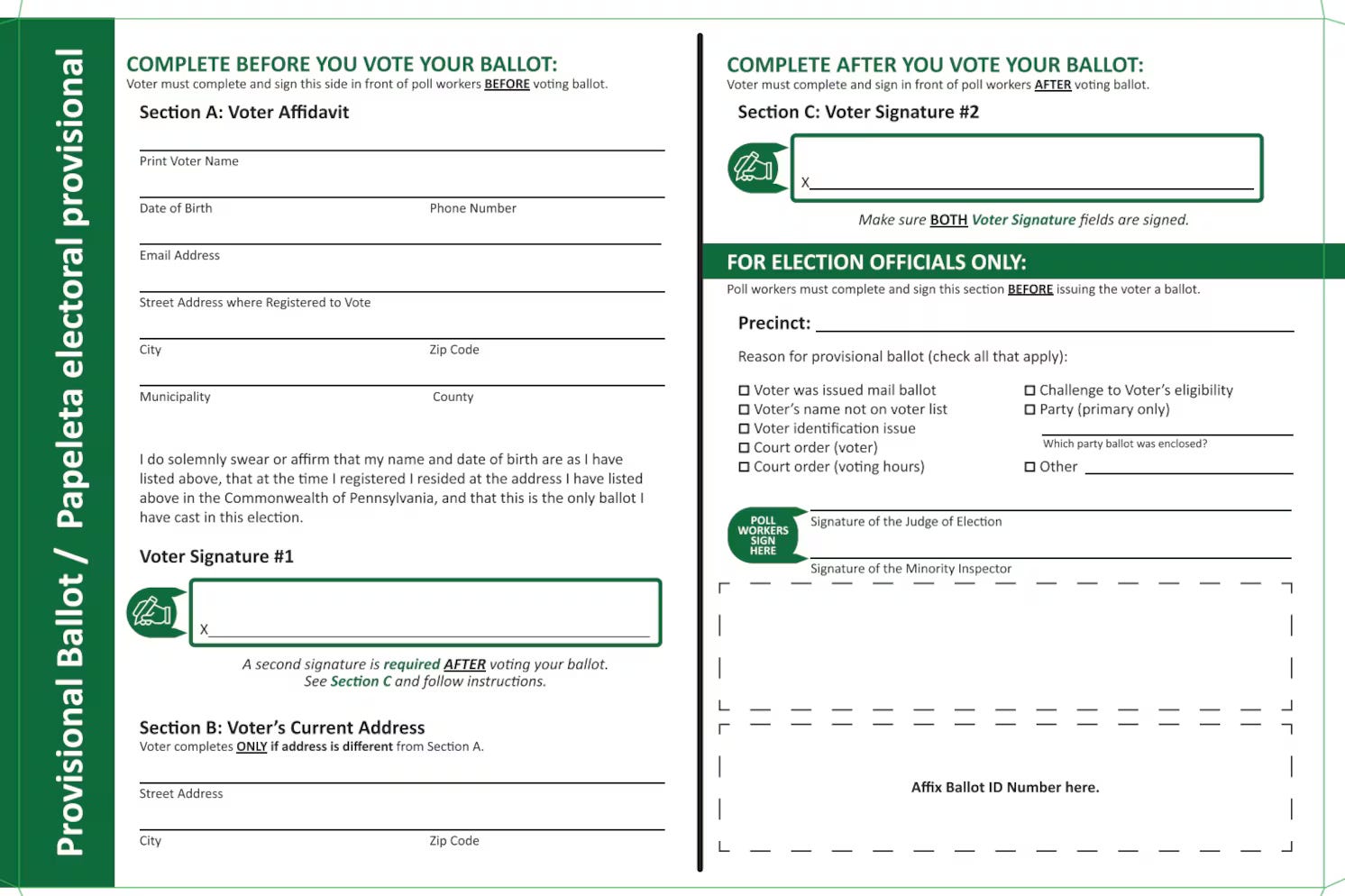
Under state election rules, ballots must arrive inside both a pre-addressed outer envelope and a smaller internal “privacy” sleeve. The error led to the disqualification of the ballots after the Bergen County Board of Elections deadlocked 3–3 on whether to allow correction, according to the New Jersey Globe, which first reported the issue on Sunday. The deadlock was along party lines, with the board’s Democratic members wanting to notify the voters, and its Republicans opposing it, according to the Globe.
B. A Closer Look At the Data
Researchers in Washington State did a deep dive into the effectiveness of voters in casting a ballot that gets counted. That state has a long history of by mail voting, but the results demonstrate that even for electorates like those in Washington State, much more MUST be done to make certain people cast a ballot that gets counted (without delay).
This September 2025 report found:
Across primary and general elections from 2020 to 2024, 1.6 percent of ballots cast were challenged for a missing signature or a signature that did not match the signature on file.
In primary and general elections since 2020, about 60 percent of ballots with signature challenges (missing signature or mismatched signature) have been cured before county elections officials submit election results to the State.
Overall, 1.4 percent of all primary ballots cast and 1.0 percent of general election ballots cast were rejected across elections from 2020 to 2024.
A very small percentage of all ballots cast were rejected for a signature that does not match the signature(s) on file – roughly about 0.5 percent of all ballots cast in any given primary or general election.
An even smaller percentage of cast ballots – just 0.2 percent – are rejected for missing a signature on the ballot envelope.
Roughly half of all ballots rejected in primary elections and in many general elections are rejected because they arrive late to county offices.
We estimate that voters of color have higher ballot rejection rates than White voters. For example, in general elections from 2020 to 2024, Black (1.3 percent), Hispanic (1.5 percent), and Asian (1.5 percent) voters experienced ballot rejection rates much higher than White voters (0.9 percent).
Self-identifying male voters have slightly higher ballot rejection rates than self-identifying female voters in both primary and general elections.
Younger voters have a much higher ballot rejection rate than older voters. Roughly 4 percent of ballots cast by voters 18 to 25 years old from 2020 to 2024 were rejected, compared to less than 1 percent of ballots cast by voters 66 or over during that time. Younger voters are much more likely to have ballots rejected due to signature mismatch than older voters.
As usual, see the attached PDF for the full article, including all of the footnotes and graphics.